|
PG-13
for war violence, bloody images, some strong language, and smoking.
Starring
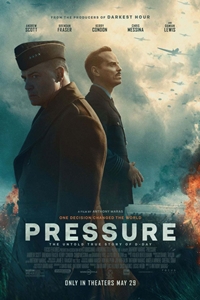
Andrew Scott, Brendan Fraser, Kerry Condon, Chris Messina, Damian Lewis
Director
Anthony Maras
Producer
Tim Bevan, Eric Fellner, Lucas
Genres
Thriller
Historical
War
Released by
Focus Features on
5/29/2026
Nationwide
|
Trailer
Review
As something of a World War II buff, I know a thing or two about D-Day. Yet the story told in Pressure, based on real events as presented in David Haig's stage play of the same name, was partially new to me. While I knew the weather played a significant part in choosing June 6, 1944, for the invasion, I didn't realize the crucial role the meteorologists played or the lack of consensus behind their forecasts. The narrative laid out in this film - whose release was timed to coincide with the 82nd anniversary of the Normandy landings - provides a fascinating look at these behind-the-scenes dynamics. I found it to be engaging, though I will concede that some viewers might find the material a little on the dry side.
The chief focal point of Pressure is the battle of egos between Captain James Stagg (Andrew Scott), championed by Churchill as a meteorological genius, and Colonel Irving P. Krick (Chris Messina), Ike's personal weatherman since North Africa. Krick's preferred method for making long-range forecasts is to use historical analogs. Stagg largely dismisses this approach, opting instead to pore over detailed pressure and wind-speed data to determine how things are most likely to play out. Although Stagg is technically in charge of the meteorological department, Krick already has Ike's ear. Furthermore, no one - neither Ike (Brendan Fraser) nor his personal assistant, Captain Kay Summersby (Kerry Condon) - particularly likes the abrasive newcomer Stagg.
With D-Day originally scheduled for Monday, June 5, Ike demands a definitive weather report on Friday, June 2. In 1944, predicting the weather three days in advance without satellite technology or computers was considered more art than science - and was as often wrong as right. Relying on his analogs, Krick confidently decides it will be sunny and fair, providing excellent conditions for hitting the beaches in Normandy. Stagg vehemently disagrees. He sees a monster storm brewing and expects a high-pressure system to retreat, resulting in catastrophically bad weather over France at the proposed invasion time. Under immense pressure, Ike must side with either Stagg or Krick and pray he doesn't make the wrong choice.
Andrew Scott portrays Stagg as something of a prig - apparently a true-to-life interpretation - but grounds him with deep humanizing characteristics. Stagg is continually distracted by a harrowing domestic situation: his pregnant wife was giving birth in a hospital when the building was bombed, leaving him entirely in the dark as to whether she is alive or dead. Chris Messina's Krick is a stereotypically cocky Yank, presenting a perfect foil for Stagg, while Kerry Condon's Summersby is note-perfect based on historical accounts. That leaves Brendan Fraser's Ike. I wish I could say Fraser nails the performance, but the physical mismatch makes full immersion difficult. Too often, I felt I was watching Fraser play Eisenhower rather than simply watching Eisenhower. There really is no definitive cinematic version of Ike (unlike, say, George C. Scott's Patton), leaving the door cracked, but Fraser fails to kick it open.
The movie ends with an effective re-creation of D-Day. While not Saving Private Ryan gruesome, the imagery is visceral, leaving no doubt about the harrowing reality without resorting to showing every grim detail (Pressure carries a PG-13 rating compared to Saving Private Ryan's hard R). Director Anthony Maras skillfully cuts back and forth between glimpses of the events on Utah and Omaha beaches and the agonizingly tense atmosphere in the operation room, where Ike, Stagg, Summersby, and Marshall Bernard Montgomery (Damian Lewis) monitor the carnage. This easily represents the film's standout sequence.
I enjoyed the slow-burn tension in the struggle between Stagg and Krick, although parts of their clash feel a little over-familiar. Still, it's a refreshing change of pace to see meteorologists framed as heroic figures, defying the old punchline: "In what other profession can you be wrong half the time and still keep a job?" Maras struggles somewhat with the inherently difficult task of making the nuts and bolts of a weather forecast cinematic, but he ultimately pulls it off. Pressure succeeds as a solid example of historical dramatization; the core circumstances, events, and figures are real, even if many interpersonal details have been invented. The result is engrossing, although the film is not likely to be remembered alongside the great movies about the war in Europe. Nevertheless, a workmanlike production of this caliber is a welcome option amid 2026's lackluster early-summer sweepstakes.
© 2026 James Berardinelli
|
|